
Data Source: Reserve Bank of India Monthly Bulletin, Table 36 — Outward Remittances under the Liberalised Remittance Scheme (LRS) for Resident Individuals, published April 23, 2026. All figures in US$ Million.
Every month, the Reserve Bank of India quietly releases one of the most revealing scorecards of Indian household ambition, the Liberalised Remittance Scheme (LRS) data.
For those of us in the foreign exchange and cross-border payments industry, this table tracks the real-world cost of families sending their kids to college abroad or finally taking those bucket-list trips.
The February 2026 data, published on April 23, tells a story of seasonal rhythms, a powerful year-on-year expansion, and a fascinating shift in why Indians are moving money abroad.
The Full Picture: Where Does the Money Go?
| Category | FY 2024-25 (Full Year) | Feb ’25 | Dec ’25 | Jan ’26 | Feb ’26 | YoY % |
|---|---|---|---|---|---|---|
| Total LRS | 29,563.12 | 1,964.21 | 2,263.67 | 2,680.43 | 2,338.60 | +19.1% |
| Travel | 16,964.57 | 1,090.61 | 1,300.17 | 1,658.33 | 1,307.03 | +19.8% |
| Maintenance of Close Relatives | 3,722.03 | 234.99 | 262.70 | 270.97 | 266.18 | +13.3% |
| Investment – Equity/Debt | 1,698.94 | 173.84 | 218.14 | 178.86 | 265.99 | +53.0% |
| Gift | 2,938.69 | 190.82 | 201.30 | 185.82 | 202.09 | +5.9% |
| Studies Abroad | 2,918.91 | 182.17 | 165.88 | 267.42 | 175.68 | -3.6% |
| Deposit | 705.26 | 51.62 | 54.60 | 48.60 | 56.90 | +10.2% |
| Purchase of Immovable Property | 322.82 | 28.76 | 47.90 | 57.33 | 51.36 | +78.6% |
| Medical Treatment | 81.19 | 3.43 | 4.20 | 4.68 | 4.21 | +22.7% |
| Donations | 11.81 | 0.59 | 0.89 | 0.55 | 0.86 | +45.8% |
| Others | 198.90 | 7.38 | 7.89 | 7.87 | 8.30 | +12.5% |
Indians remitted USD 2,338.60 million in February 2026 under the LRS, down about 12.8% from January’s elevated figure of USD 2,680.43 million, but up by 19.1% compared to February 2025’s USD 1,964.21 million. That year-on-year growth number, crossing nearly $374 million of additional outflow in a single month’s comparison, is not a blip. It is a structural trend. Let’s find out how it happened.
My View: “The month-on-month dip from January to February is almost always seasonal. January is a peak time for both travel and study abroad related remittances”
Travel: Still the Undisputed King
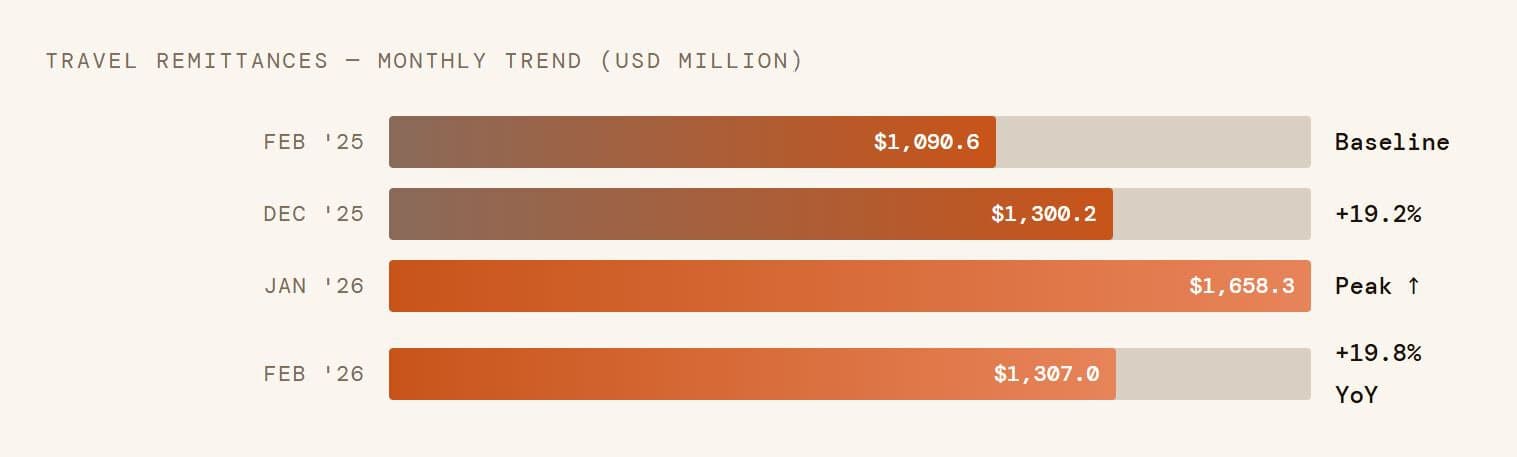
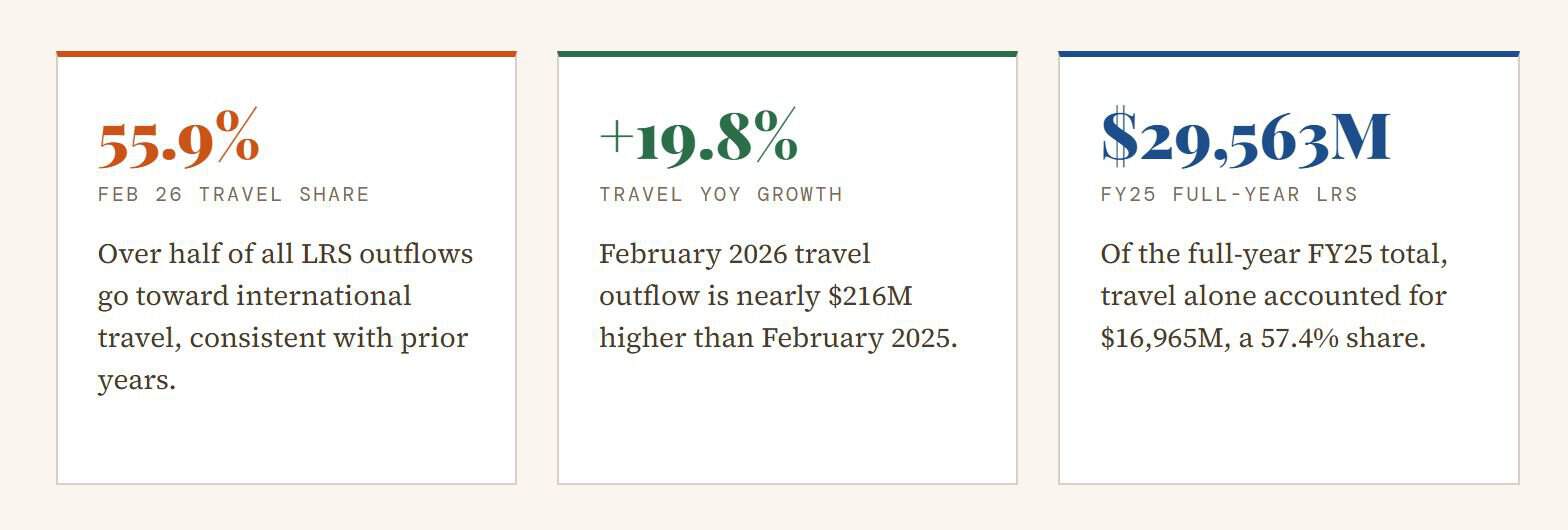
Travel remittances, the money Indians send or use abroad for international trips, forex cards, and trip expenses, continues to dominate the LRS landscape at $1,307.03 million in February 2026, representing a commanding 55.9% of all LRS outflows. This is virtually identical to travel’s share in the same month last year (55.5%), confirming that Indian’s wanderlust is holding steady inspite of adverse international conditions.
The month-on-month decline from January’s $1,658.33 million is steep at first glance, a drop of $351 million or 21.2%.
But this requires context.
January is a globally elevated travel month for Indians, it captures the Republic Day long weekend, the thick of winter holiday travel, and the New Year break, spending that spills into early January. February, being a shorter calendar month with fewer long weekends, naturally sees lower travel forex outflows.
The better comparison is year-on-year: February 2026’s travel outflow is $216 million, or 19.8%, higher than February 2025’s $1,090.61 million. That is the real story.
From what we see at ExTravelMoney, the travel forex demand is not just growing in numbers, but also changing in nature.
Customers are spending more on average, choosing a wider range of destinations beyond the usual UAE, US, and UK routes, and more students and young professionals are buying forex for their first international trips.
This shows that overseas travel is becoming more common among India’s growing middle class.
The Investment Surge: India Goes Global with Capital
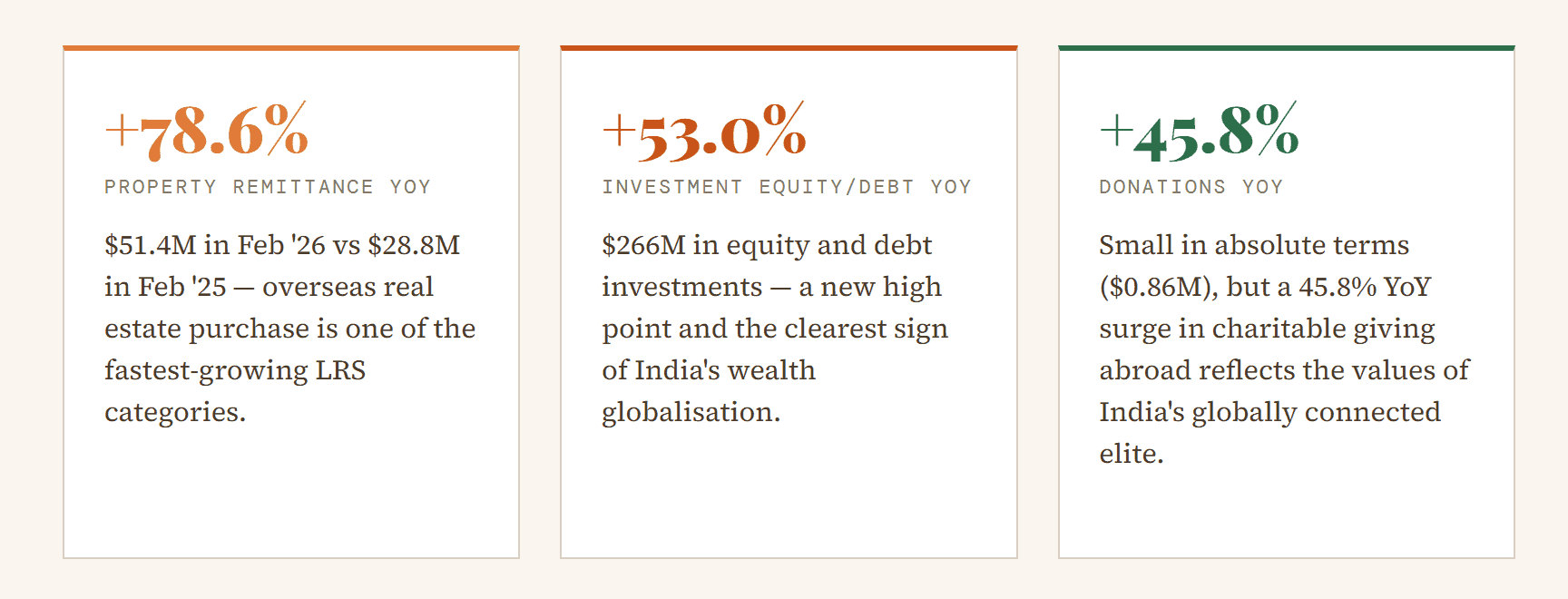
The most striking single movement in February 2026’s data, and the one I believe will define the decade ahead, is the dramatic spike in Investment in Equity and Debt. At $265.99 million, February 2026 investment outflows represent a 48.7% jump over January 2026’s $178.86 million, and a remarkable 53% surge year-on-year over February 2025’s $173.84 million.
This is not a random behaviour. This is Indians systematically building offshore investment portfolios. US equities, international ETFs, global bond funds, and alternative assets. The $250M-plus level for investment remittances, which was rare just two years ago, is becoming the new normal.
My View: “A 53% year-on-year surge in equity and debt investment remittances is one of the most consequential shifts in the LRS data. Indian retail investors are not just investing in the Nifty, they are building dollar-denominated wealth portfolios.”
What is driving this?
A mixture of factors. Many Indian investors are trying to reduce their dependence on the Indian stock market alone. When domestic markets become uncertain, they look at global markets to spread their risk and access opportunities in companies and sectors that may not be available in India.
Fintech platforms have also made overseas investing easier than before.
At the same time, more people are becoming aware of the benefits of holding some wealth in foreign currency, especially with the rupee weakening over the long term. The strong performance of US tech stocks has also added to this interest.
For wealthier families, the annual LRS limit of USD 250,000 is now starting to feel smaller than it once did.
Maintenance of Close Relatives: The Diaspora Dividend
At $266.18 million, maintenance remittances, money sent by Indian residents abroad to support family members, held remarkably steady, inching up from December 2025’s $262.70 million and roughly flat with January’s $270.97 million. Year-on-year, this is a 13.3% increase over February 2025’s $234.99 million.
This category reflects India’s deep ties with the global diaspora.
A large and growing segment of Indian households has at least one member studying or working abroad, and the LRS “maintenance” bucket captures the reverse flow: Indian residents supporting parents, siblings, or spouses who have settled outside India.
The consistency of this number suggests it is essentially a recurring, contractual outflow.
Studies Abroad: January’s Spike Explained
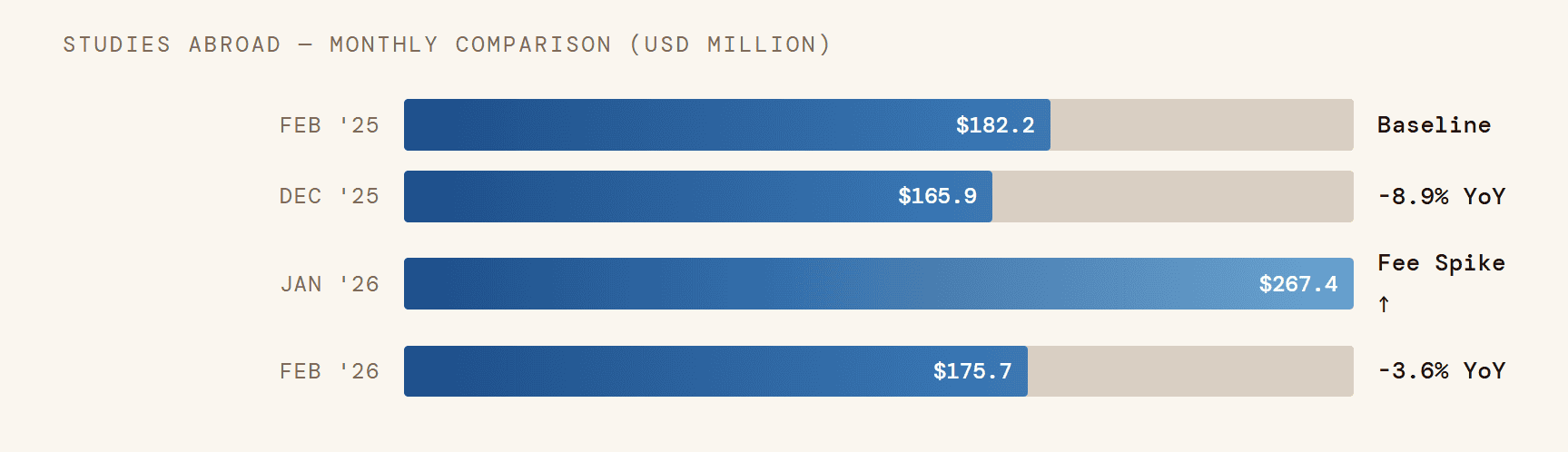
January 2026 showed an extraordinary $267.42 million, the highest of any month in recent times, before dropping to $175.68 million in February.
This is classically explained by the academic calendar: January is when spring semester fees for Western universities are due, creating a concentrated wave of tuition fee remittances.
February normalises. At $175.68 million, February 2026’s education remittances are actually 3.6% below February 2025, the only major category showing a year-on-year decline.
Also Read: How to Send Money Abroad for Your Child’s Education
This slight dip is worth monitoring.
Is it a sign that fewer Indians are pursuing international education, that fee payment patterns are shifting, or simply a calendar quirk in how January absorbed more of the academic year’s early fees?
I lean toward the last explanation for now, based on ExTravelMoney’s own remittance data.
This is most probably due to tighter student visa policies in key destination countries like Canada and the UK.
Real Estate Abroad: A Growing Appetite
Purchase of immovable property remittances came in at $51.36 million in February 2026, well above the prior year’s $28.76 million, a year-on-year increase of 78.6%. Even compared to an elevated January figure of $57.33 million.
This is the category I watch most closely as a leading indicator of wealth formation among India’s upper-middle class and HNI segment.
Buying property abroad, whether in Dubai, London, Lisbon, or Singapore, requires not just wealth but confidence and intent.
The sustained elevation of this category through Q3 and Q4 of FY26 tells me that Indian appetite for overseas real estate has genuinely structurally shifted upward from the sub-$30M monthly levels of two years ago.
Gift Remittances: Cultural Ties and Festival Money
The Gift category, which covers money sent abroad as gifts to individuals, settled at $202.09 million, up 5.9% year-on-year and marginally above December 2025’s $201.30 million.
This is one of the more culturally layered categories in the LRS data. It captures everything from Pongal, Lohri, Holi and Diwali money sent to relatives abroad, to wedding gifts, to informal financial support between family members that doesn’t qualify as “maintenance.”
The remarkable consistency of gift remittances, hovering between $185M and $205M across most months, suggests that gifting abroad has become a regular pattern of support within India’s globally dispersed family networks. Its steady YoY growth of ~6% tracks reasonably well with disposable income growth among upper-middle-class Indians.
Also Read: Sending Gift Remittances to Europe: Everything You Need to Know
What the Full-Year Trajectory Tells Us
Stepping back, the full FY2024-25 figure of $29,563.12 million gives us the annual run rate.
February 2026 alone was $2,338.60 million, equivalent to an annualised run rate of roughly $28 billion if every month were like February, and higher if we factor in the peak months.
All signs point to FY2025-26 exceeding FY2024-25.
To contextualise, India’s LRS outflows have grown from under $10 billion annually five years ago to nearly $30 billion today. The number of LRS transactions has grown substantially.
What This Means for the Forex and Remittance Industry
Travel Forex: Volume and Value Both Growing
For companies operating in the travel forex space, including ExTravelMoney, the consistent 19-20% year-on-year growth in travel outflows is an invitation to scale.
But volume growth alone is not the prize.
The prize is moving up the value chain: offering better rates, faster processing, seamless digital delivery of forex cards and currency, and bundled travel financial services.
Investment Platforms: The Emerging Battleground
The $265 million in equity/debt investment remittances in a single month signals that India’s LRS is no longer a travel-and-education story.
Investment platforms, from established brokers to fintech upstarts offering fractional US stock ownership, are fighting for this growing pie.
The regulatory environment under FEMA and the LRS framework is supportive, the demand is evident, and the technology exists. This will be one of the most competitive growth areas in Indian fintech over the next three years.
Overseas Education: A Market Under Pressure
While overseas education has historically been one of the major reasons Indians send money abroad, the near-term outlook is no longer as strong as it was between 2019 and 2023.
The rupee’s sharp fall against the US dollar has made tuition fees and living expenses significantly more expensive for Indian families.
At the same time, key destinations such as Canada, the UK, and the US have become less welcoming through tighter visa rules, reduced post-study work options, higher financial requirements, and stricter immigration scrutiny.
This is already visible in the numbers.
February 2026 education remittances stood at $175.68 million, lower than February 2025, while January’s spike appears more like a fee-payment timing effect than proof of sustained growth.
From ExTravelMoney’s own transaction trends too, demand for Canada-related student remittances appears far weaker now compared to the 2019–2023 period.
This segment will remain under pressure in the immediate future.
Families who still choose to send students abroad will be more cost-conscious than before, comparing exchange rates closely, timing their payments carefully, and looking for ways to reduce the total cost of remittance.
For forex and remittance providers, the opportunity is not just in volume growth, but in helping families save money in a tougher and more uncertain study-abroad environment.
My View: “Every line in the RBI’s LRS table represents not just a dollar amount, but a dream of travel, of education, of building wealth beyond borders. Our job is to make those dreams financially smoother and more affordable.”
My Outlook for the Months Ahead
March and April 2026 should see a seasonal bounce in travel outflows, driven by the summer holiday booking season and school break travel.
Investment remittances, if global equity markets remain favourable, could sustain or even surpass February’s elevated levels.
Education remittances will likely tick up again in July-August with the start of the new academic year abroad.
One policy variable to watch is the recent lowering of Tax Collected at Source (TCS) on foreign remittances. With lowered TCS for overseas tour packages, education and medical remittances under LRS, this should make legitimate forex transactions less painful for customers.
That said, the impact will depend on how the revised rules are implemented across banks, authorised dealers, and online forex platforms.
For the industry, simpler and more predictable TCS rules could support better reporting, smoother customer experience, and stronger formal-channel remittance volumes.
Also Read: New TCS Proposals on International Money Transfer in Budget 2026

George Zachariah, with over 20 years of experience in banking and foreign exchange, is the CEO of ExTravelMoney.com. Known as a thought leader in the industry, George has shaped ExTravelMoney.com to become a key player in the forex market.